

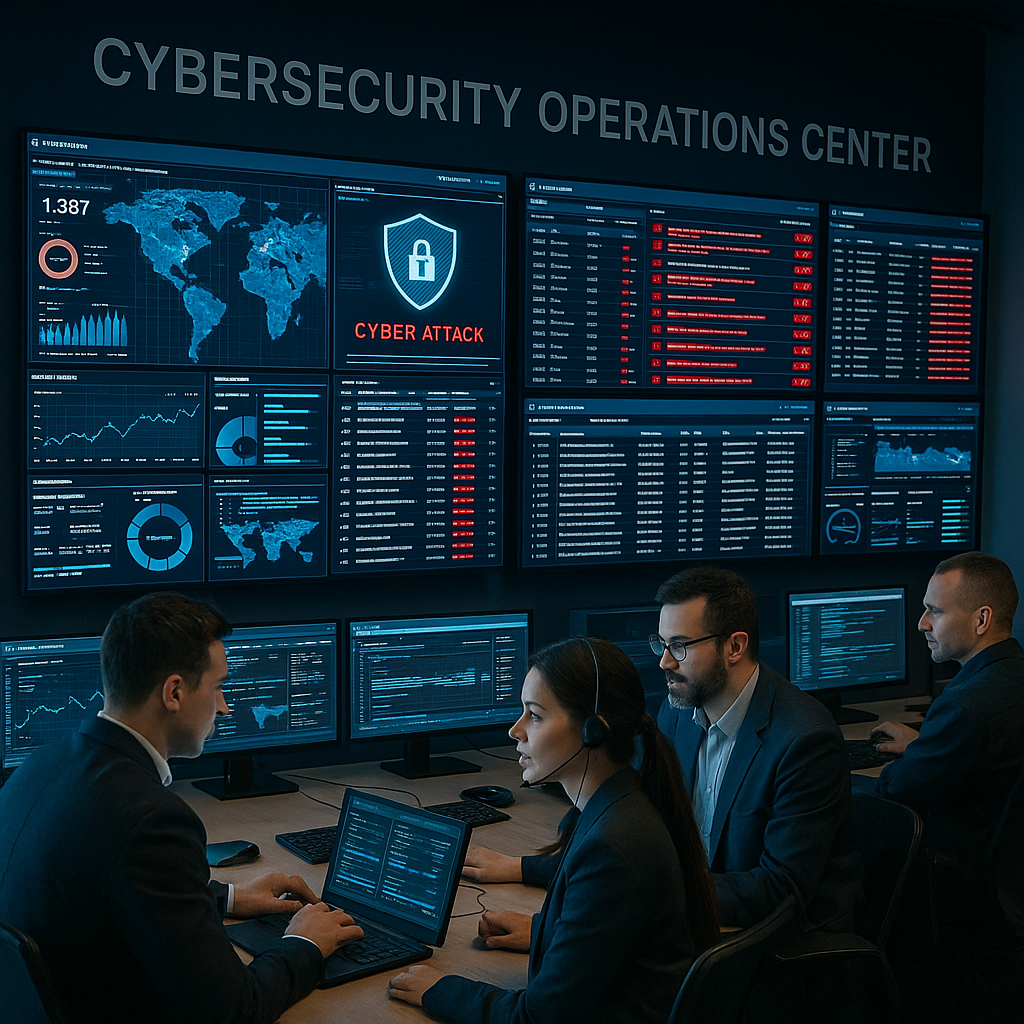
New Jersey community banks face sophisticated cyber threats daily, yet many lack the resources to maintain a full-scale Security Operations Center—discover how shared infrastructure and strategic partnerships can deliver enterprise-grade protection without enterprise-scale budgets.
Understanding the Cybersecurity Resource Gap Facing Community Banks
Community banks across New Jersey operate in an increasingly hostile cyber threat landscape. Financial institutions of all sizes face identical adversaries—sophisticated threat actors who employ advanced persistent threats, ransomware campaigns, and credential harvesting tactics. Yet while large banks deploy teams of security analysts, threat hunters, and incident responders supported by multi-million dollar security operations centers, community banks face these same enterprise-grade threats with constrained security staffing and tooling budgets.
The resource disparity creates a dangerous vulnerability. Community banks often lack dedicated cybersecurity personnel, relying instead on IT generalists who must balance security responsibilities with system administration, help desk support, and infrastructure maintenance. These professionals may understand their networks and business processes intimately, but they lack the specialized training, time, and tooling necessary to detect sophisticated intrusions, analyze complex security events, or coordinate effective incident response.
This gap is not merely theoretical. Regulatory expectations continue to rise, with frameworks like the NIST Cybersecurity Framework establishing clear expectations for detection and response capabilities. Meanwhile, threat actors increasingly target regional and community financial institutions precisely because they recognize the resource constraints that limit defensive maturity. The question facing community banks is not whether to improve security operations, but how to achieve enterprise-grade cyber defense without enterprise-scale budgets or staffing models.
Core Components of Effective SOC Support for Financial Institutions
A functional Security Operations Center for financial institutions requires several interconnected capabilities working in concert. Log aggregation and correlation form the foundation—collecting security-relevant telemetry from endpoints, network devices, authentication systems, and business applications, then normalizing and enriching this data for analysis. Without centralized visibility across the technology stack, defenders operate blind to adversary movement and cannot distinguish malicious activity from routine operations.
Detection engineering translates threat intelligence into actionable alerts. Effective detection rules identify specific adversary behaviors—lateral movement techniques, credential abuse patterns, data exfiltration attempts—based on documented tactics, techniques, and procedures rather than generic signatures. These detections must be tuned to the specific environment, balancing sensitivity with operational noise to ensure analysts can investigate alerts efficiently without drowning in false positives.
Alert triage and investigation capabilities transform raw detections into contextualized security events. Skilled analysts review alerts, gather additional context from related log sources, correlate activity across timeframes and systems, and determine whether observed behavior represents genuine threats requiring escalation or benign activity that can be documented and closed. This investigative work requires both technical skill and institutional knowledge of normal business operations.
Incident response orchestration provides the procedures and coordination necessary when investigations confirm active threats. Response playbooks guide analysts through containment actions, evidence preservation, stakeholder notification, and remediation steps appropriate to the incident severity and type. For community banks, these capabilities traditionally required either building an internal security team or accepting gaps in defensive coverage. Shared infrastructure models offer a third path—accessing these SOC capabilities through collaborative arrangements that preserve institutional boundaries while delivering enterprise-grade protection.
Leveraging Shared Infrastructure for Enterprise-Grade Cyber Defense
Shared security infrastructure allows community banks to access sophisticated detection and response capabilities without independently deploying and maintaining complex security stacks. The model operates on straightforward principles: core security tooling, threat intelligence platforms, and analytical workflows are deployed once and operated collectively, with logical separation ensuring each institution's data remains isolated and privacy boundaries are respected.
Cost-effective, open-source security tooling forms the technical foundation of this approach. Rather than proprietary platforms that create vendor lock-in and unpredictable licensing costs, shared infrastructure leverages proven open-source technologies for log collection, security information and event management, endpoint detection and response, and network traffic analysis. These tools provide enterprise-grade capabilities while maintaining transparency in their operation and flexibility for customization to specific institutional needs.
The shared model addresses both the staffing and budget constraints that limit community bank security operations. By distributing infrastructure costs across multiple institutions and centralizing operational expertise, participating banks gain access to continuously monitored security platforms, regularly updated detection content, and experienced security analysts—capabilities that would be prohibitively expensive to build independently. Critically, this sharing occurs at the infrastructure and expertise level, not the data level. Each bank's security telemetry remains logically isolated, with analysis performed within clearly defined boundaries.
Implementation begins with structured, time-bound pilot engagements that define scope and success criteria before any operational activity commences. These pilots establish what data will be collected, how it will be analyzed, what detection content will be deployed, and how findings will be communicated. Early involvement of legal, risk, and compliance teams ensures alignment with regulatory obligations and institutional risk tolerances. This deliberate approach avoids the ambiguity and scope creep that often plague security initiatives, replacing uncertainty with verifiable commitments and measurable outcomes.
Threat Intelligence Aligned to Real Adversary Behavior
Effective threat intelligence moves beyond generic vulnerability announcements and industry newsletters to focus on documented adversary behavior. Frameworks like MITRE ATT&CK provide structured taxonomies of the tactics, techniques, and procedures that threat actors actually employ during intrusions. This structured mapping transforms abstract threats into concrete, verifiable attack methods that defenders can detect, investigate, and mitigate.
For community banks, threat intelligence aligned to real adversary behavior enables precise prioritization of defensive effort. Rather than attempting to address every conceivable risk or chasing headline threats with limited relevance to financial institutions, security teams can focus on the specific techniques most commonly employed against banks—credential abuse through phishing campaigns, exploitation of internet-facing applications, lateral movement via legitimate administrative tools, and data theft targeting customer information or transaction systems.
Context-aware processes support investigation and prioritization while respecting data boundaries. When a detection fires, analysts need sufficient context to determine whether the activity represents a genuine threat or expected behavior. This context includes understanding normal business processes, seasonal activity patterns, ongoing projects that may generate unusual network traffic or system changes, and the specific risk profile of different systems and data types. Shared security operations must incorporate institutional context without requiring unnecessary sharing of sensitive business information.
Threat intelligence integration is not a one-time activity but an ongoing process of refinement. As adversary techniques evolve, new detection content must be developed, tested, and deployed. As false positives are identified and investigated, detection rules require tuning to improve signal-to-noise ratios. This continuous improvement process ensures defensive capabilities mature over time, progressively closing gaps and improving mean time to detection and response.
Building Detection and Response Maturity Through Structured Engagement
Improving security operations maturity requires a practical path forward that acknowledges current resource constraints while establishing clear progression toward enhanced capabilities. Structured engagement models provide this path through phased implementation that builds capabilities incrementally, demonstrates value at each stage, and maintains transparency throughout the relationship.
Initial phases focus on establishing foundational visibility. Log collection begins with high-value data sources—authentication logs, endpoint security events, firewall and proxy traffic, critical server activity—that provide maximum investigative utility relative to collection and storage costs. Detection content starts with high-confidence rules targeting unambiguous malicious activity, ensuring early alerts represent genuine threats rather than tuning exercises. This foundation proves the model's value while building institutional confidence.
Subsequent phases expand coverage and analytical depth. Additional log sources provide broader visibility into network activity, application behavior, and user actions. More sophisticated detection content identifies subtle indicators of compromise—reconnaissance activity, privilege escalation attempts, persistence mechanism deployment—that require deeper analysis but provide earlier warning of intrusions. Threat hunting activities proactively search for adversary presence using hypotheses derived from threat intelligence and observed environmental patterns.
Throughout this progression, all changes to tooling, configuration, or operating assumptions are deliberate and clearly communicated. Community banks retain visibility into what data is being collected, how it is being analyzed, what detection logic is being applied, and how findings are being interpreted. This transparency builds trust and ensures alignment with institutional risk tolerance and regulatory obligations. The goal is not merely to deploy security technology but to improve detection, analysis, and response maturity in measurable, sustainable ways that make core cybersecurity capabilities accessible without requiring enterprise-scale resources or creating vendor dependencies.